Back to home
Properties of the Infinite Sum of a Real Number's Prime Powers
Consider the series
 ,
where
,
where
 is an arbitrary real number and
 is the
 th
prime. That is, the series
th
prime. That is, the series
 .
Equivalently, this series can be written as
.
Equivalently, this series can be written as
 ,
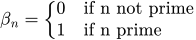
where
,
where
 .
For what values of
does this series converge?
.
For what values of
does this series converge?
Clearly,
 ,
so by the direct comparison test the series must converge absolutely
wherever the geometric series
,
so by the direct comparison test the series must converge absolutely
wherever the geometric series
 converges absolutely. That is, the series converges absolutely
 .
If
.
If
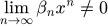
 ,
then
,
then
 ,
so the series diverges. If
,
so the series diverges. If
 ,
then the series becomes
,
then the series becomes
 ,
diverging to
,
diverging to
 .
if
.
if
 ,
then the series becomes
,
then the series becomes
 ,
diverging to
,
diverging to
 .
We conclude that
,
converges on
.
We conclude that
,
converges on
 and nowhere else on the real line.
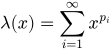
We can now define a function
 as
as
 .
Here is the graph of
.
Here is the graph of
 ,
with
,
with
.svg) approximated up to the
approximated up to the
 term:
term:
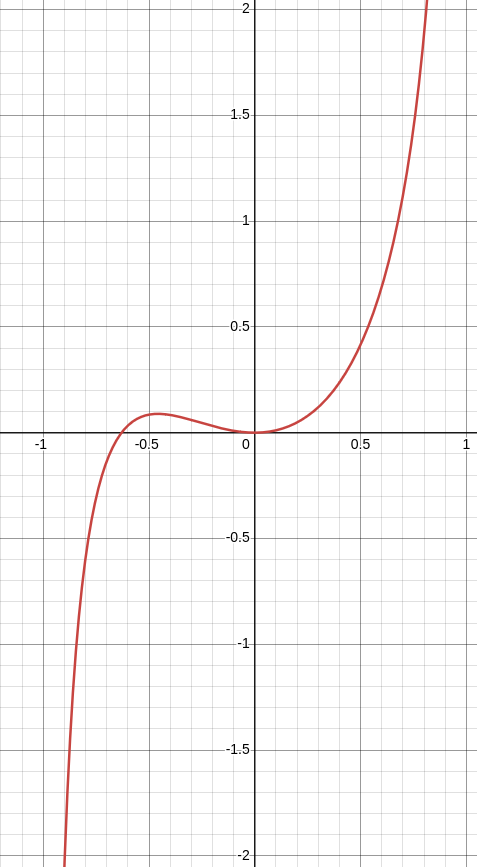
Based on this graph, it would appear that
 is continuous, that
 is
,
and that
is
,
and that
 is
.
It also appears that the function is increasing for
-values
from the left edge of the domain to about -0.5, then decreasing up to
about zero, then increasing again up to the right edge of the domain. Let
us see how many of these properties we can prove.
is
.
It also appears that the function is increasing for
-values
from the left edge of the domain to about -0.5, then decreasing up to
about zero, then increasing again up to the right edge of the domain. Let
us see how many of these properties we can prove.
Since
is defined by a convergent power series, it is an analytic function,
which implies, among other things, that it is continuous. The derivative
of
is
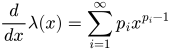 ,
or
,
or
 .
Since all primes besides 2 are odd, every term in this series except the
first is of even order. For
.
Since all primes besides 2 are odd, every term in this series except the
first is of even order. For
 ,
all the even-order terms in the definition of
,
all the even-order terms in the definition of
 are positive and the single odd-order term is negative. Whether
is decreasing or increasing, therefore, depends on whether
are positive and the single odd-order term is negative. Whether
is decreasing or increasing, therefore, depends on whether
 .
Approximately, it seems that
is increasing on (-1, -0.457) and decreasing on (-0.457, 0).
For
.
Approximately, it seems that
is increasing on (-1, -0.457) and decreasing on (-0.457, 0).
For
 ,
each term is positive, so
is positive, so
is increasing.
At the moment I am unable to find proofs of the one-sided limits at 1 and
-1.
,
each term is positive, so
is positive, so
is increasing.
At the moment I am unable to find proofs of the one-sided limits at 1 and
-1.